Weeks 1–2
Pain
Calm what’s flaring up.
Hands-on techniques ease current discomfort and calm the irritated muscles around your curve, starting your very first visit.
What We Treat
One shoulder sitting higher, a back that’s worn out by evening, and years of being told to live with it. A curve can be managed instead of ignored.
Sound Familiar?
Two or more? Keep reading.
Why It Happens
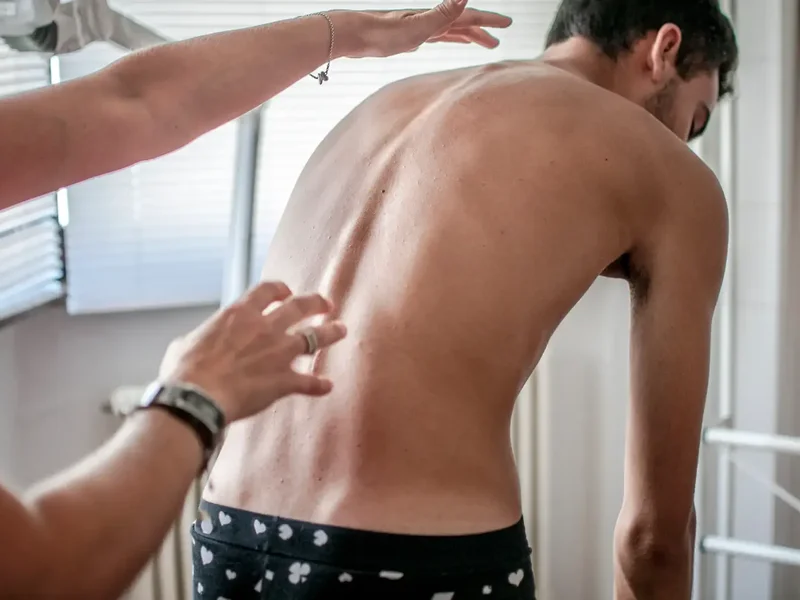
Physical therapy won’t straighten the curve itself. That’s not what it’s built to do, and anyone who tells you otherwise isn’t being straight with you. But the pain, stiffness, and fatigue that come along with scoliosis are usually driven by something PT can absolutely change: the muscles on either side of your spine pulling unevenly, working overtime just to hold you upright. Rebalance that support, and a lot of the discomfort eases, even though the curve on an X-ray stays the same shape.
That’s why a real, cause-first evaluation matters. It maps exactly which muscles are overworked, which are underused, and which movement patterns are quietly making your specific curve harder to live with. Two people with the same curve can hurt in completely different ways, so a generic exercise sheet rarely fits. And if you’ve been told for years there was nothing to do but live with it, that wasn’t giving up. That was doing the best with what you were told. Find what’s actually driving your discomfort, and the plan gets obvious.
The Honest Truth
Nobody regrets starting too early. Every week, someone in our clinic says they regret waiting.
How We Fix It
Every plan has an endpoint. Here’s what the four phases look like for scoliosis.
Weeks 1–2
Pain
Hands-on techniques ease current discomfort and calm the irritated muscles around your curve, starting your very first visit.
Weeks 2–6
Prime
Targeted mobility work restores movement and rebalances the muscles supporting both sides of your curve.
Weeks 6–10
Perform
Progressive, targeted strengthening builds up the side of your spine that’s been carrying less of the load.
Weeks 10+
Prevent
The structural curve itself remains, so you leave with a long-term plan for managing comfort and posture on your own: that’s the endpoint, not just another appointment.
If you are searching for personalized and compassionate care, look no further. Brad and his team at Focus are the absolute best! I have been a patient of Brad’s for many years and wouldn’t go anywhere else. I am doing great thanks to Brad and his expertise and encouragement.
Shared by Denese D.
Before: searching for care that actually felt personal
Now: years in, and still doing great
Questions, Answered
No, physical therapy doesn’t correct the structural curve itself, and any program that promises otherwise isn’t being straight with you. What PT can do is meaningfully reduce the pain and stiffness tied to your scoliosis, rebalance the muscles supporting your spine, and improve how you move and function day to day. For most people, that’s the difference that actually matters.
Yes, with the right approach. Movement doesn’t make a curve worse, and avoiding exercise usually just weakens the muscles that are supposed to support your spine. The key is choosing exercises dosed for your specific curve, which is exactly what a Doctor of Physical Therapy sorts out at your evaluation, then progresses safely as you get stronger.
Most patients move through the initial four phases, Pain, Prime, Perform, and Prevent, over 8–10 weeks. That gives you a plan with an endpoint: you’ll always know which phase you’re in and what’s left. Because scoliosis itself is a lifelong condition, some patients choose periodic maintenance visits afterward to stay ahead of it, but that’s optional, not required.
Book Your Visit
Request a time and a real person calls you back, usually within two business hours. No phone tree. No ‘someone will reach out.’ Just a plan.
5.0 · 213 Google reviews
Typical response: under 2 business hours
Step 1 of 5
That’s the hard part done. We’ll call during business hours to lock in your time. Most people are on the schedule same week.
Visit Us